Search
Search our projects, research and resources
INTERESTED IN WHAT WE CAN DO FOR YOU?
What Makes a Website Premium? 8 Elements of High-End Web Design
A premium website is a custom-designed, fast and intuitive site where every element (brand identity, visual hierarchy, imagery, UX, motion, performance, content and scalability) is chosen to serve the brand and its audience. It isn’t defined by how much it costs or how many effects it has, but by how thoughtfully it has been built.
An impressive homepage isn’t enough. Visitors judge a business within seconds, and a website that merely looks good won’t keep them on your site.
The most effective websites combine distinctive design, intuitive user experience, strong performance and clear strategy, so the experience feels considered from the first click to the final enquiry.
True premium website design isn’t found in more animations, a fashionable colour palette or a longer feature list. It’s found in the details: how the brand is presented, how information is organised, how visitors move through the site and how seamlessly it all works together.
At KNOWN, a Cape Town web design and development agency, we treat a premium website as an extension of the brand behind it.
Every element earns its place, from typography and imagery to navigation and code.
Key takeaways
- Premium web design is defined by intent and quality of decisions, not by budget or visual extravagance.
- Eight elements separate a high-end website from a functional one: brand identity, visual hierarchy, purposeful imagery, intuitive UX, restrained motion, performance, authoritative content and future-ready foundations.
- Performance is part of the design: a premium site should meet Google’s Core Web Vitals “good” thresholds on mobile.
- A premium website must be discoverable and built for SEO and for AI search engines such as Google AI Overviews and ChatGPT, Claude or Copilot.
The 8 elements of a premium website at a glance
| # | Element | What it means | How you can tell |
|---|---|---|---|
| 1 | Distinctive brand identity | The site could only belong to your brand | Custom typography, colour and tone, not a recognisable template |
| 2 | Visual hierarchy | Design guides the eye to what matters | One clear focal point and one primary call to action per screen |
| 3 | Purposeful imagery | Visuals tell the brand story | Art-directed or custom imagery, consistent in style |
| 4 | Intuitive UX | Visitors never have to think about the site | Clear navigation, short forms, accessible to WCAG 2.2 AA |
| 5 | Restrained motion | Animation supports, never distracts | Subtle transitions that respect reduced-motion settings |
| 6 | Performance | Fast and stable on every device | Passes Core Web Vitals on mobile |
| 7 | Authoritative content | Clear, confident messaging | Answers who, what, for whom, why you and what next |
| 8 | Future-ready build | Grows with the business | Scalable CMS, clean code, structured data |
1. A Distinctive Brand Identity
A premium website feels unmistakably connected to the brand it represents. If your logo could be swapped for a competitor’s without anyone noticing, the site isn’t premium.
The fastest way to look generic is to lean on familiar layouts, stock imagery and design choices that could belong to any business. Familiar patterns help navigation, but the visual identity itself should be yours.
Typography, colour, imagery, graphic elements, tone of voice and layout all build that identity.
“A brand is a person’s gut feeling about a product, service, or company.” – Marty Neumeier, author of The Brand Gap.
The goal isn’t to be different just for the sake of it. It’s to communicate who the business is and what makes it unique.
A strong identity also creates consistency between your website and every other touchpoint, from social media to proposals, so visitors recognise and remember you.
That’s why KNOWN pairs website design with logo and brand design under one roof.
For more on building a recognisable digital identity, read our guide to Get Known.
2. Thoughtful Visual Hierarchy
Visual hierarchy is the order in which visitors notice and process information on a page. Premium design is rarely about adding more; it’s about knowing what really deserves attention.
Headlines establish importance. Supporting copy adds context. Calls to action (CTA’s) stand out without competing with everything around them.
Spacing matters just as much. Generous, intentional whitespace gives content room to breathe and stops a page feeling crowded. Typography, scale, alignment and contrast then guide the visitor naturally through the experience.
When hierarchy is right, the site feels effortless.
Visitors never have to work out where to look next, because the design guides them effortlessly.
A simple test: Each screen should have one obvious focal point and one primary action.
This matters most in the first few seconds that viewers access your website.
We unpack how to win that moment in The 3-Second Rule: Ultimate Tips To Capture User Attention Instantly.
3. High-Quality, Purposeful Imagery
Premium imagery supports the brand story, sets the right emotion and signals quality. It’s chosen for meaning, not just because it looks attractive at full-screen width.
For some brands, that means bespoke art-directed photography. For others, it’s refined illustrations, product visuals, custom graphic design or carefully curated supporting images.
Consistency is what makes it premium. Every image should belong to the same visual world as the typography, colour and wider brand identity.
One generic stock photo can undo the sense of quality across an otherwise beautiful website landing page.
Premium imagery is also built properly behind the scenes:
- Modern image formats such as WebP or AVIF, compress images without visible quality loss.
- Responsive sizes, so phones never download desktop-sized files.
- Descriptive alt text, which helps accessibility, image search and AI understanding of the page.
- Lazy loading for images below the fold, with the hero image prioritised.
4. An Intuitive User Experience
User experience (UX) is how easily visitors can find what they are looking for, understand what your brand offers and immediately take the next step. On a premium website, the journey feels natural (not forced) and the interface almost disappears.
Beautiful design means very little if people can’t find information or work out what to do next. A premium UX layout gets the fundamentals right:
- Navigation is clear, with no more top-level items than visitors need.
- Content follows a logical order, matching the questions buyers actually ask (Visual hierarchy and Information Architecture).
- Forms are short and only ask for what’s essential.
- Calls to action appear where they make sense in the journey, not everywhere at once.
- The site is accessible, meeting Web Content Accessibility Guidelines for colour contrast, keyboard navigation and screen-reader support.
Accessibility is a mark of quality, not an add-on. A website that works for everyone signals care, widens your audience and supports both SEO and compliance.
As Steve Jobs put it: “Design is not just what it looks like and feels like. Design is how it works.”
The best interfaces feel invisible because everything behaves as expected.
RELATED ARTICLE: Mastering User Experience Design Easily For Incredible Results.
5. Purposeful Motion and Interaction
Motion adds sophistication when it has a job to do: showing hierarchy, giving feedback or guiding attention. When every element moves, nothing feels important.
When designing a website it’s important to consider your website audience(s) and understand what types of micro interactions and unique website functionality would actually relate to them and add value to your website.
Subtle transitions, hover states and scroll interactions can make a site feel responsive and alive. But more animation doesn’t mean better design.
Premium interaction design is about restraint:
- Motion supports the content rather than competing with it.
- Interactions feel natural on desktop, tablet and mobile, including touch.
- Animations are light enough not to slow the page or cause layout shifts.
- The site respects visitors’ reduced-motion settings, which matters for people with motion sensitivity.
The objective isn’t to show off technology. It’s to make the experience more engaging without getting in the way.

6. Performance Behind the Design
A premium website is as fast and stable as it is beautiful. Visitors experience technical quality just as much as visual quality, and Google measures it through Core Web Vitals.
A site can look exceptional and still frustrate people if it’s slow, jumpy or awkward on a phone. That’s why performance belongs in the design brief from day one, not as an afterthought.
As a benchmark, a premium website should hit Google’s “good” Core Web Vitals thresholds for real users on mobile:
| Metric | What it measures | “Good” threshold |
|---|---|---|
| Largest Contentful Paint (LCP) | How quickly the main content loads | 2.5 seconds or less |
| Interaction to Next Paint (INP) | How quickly the page responds to taps and clicks | 200 milliseconds or less |
| Cumulative Layout Shift (CLS) | How stable the layout is while loading | 0.1 or less |
Getting there means optimised images, lean code, quality hosting, caching and a responsive layout that adapts smoothly to every screen size. Mobile matters most, because that’s where most visitors first meet your brand.
NOTE: Google ranks all websites on ‘mobile first’ criteria, which makes sense when you realise that more people own smartphones compared with personal computers.
At KNOWN, design and web development work together from the first wireframe, so the technology underneath supports the experience on top.
RELATED ARTICLE: Mobile-First Website Design: Why It’s Essential for Businesses in 2026.
7. Content That Communicates Authority
Even exceptional design can’t compensate for unclear content. A premium website speaks with the confidence and expertise of the business behind it.
Within a few seconds, your content should make five things clear:
- Who the business is.
- What it offers.
- Who it helps.
- Why it is different.
- What visitors should do next.
The brand voice and tone should feel authentic, not inflated with exaggerated claims.
Proof beats promises: Case studies, client testimonials, named team members and real results build trust with people and with search engines alike.
Structure content for how people actually read online, and how AI assistants extract answers.
That means descriptive headings, concise sections that open with a direct answer, lists and tables for comparisons, and FAQs that answer real buyer questions.
When compelling content and considered design work together, the website becomes more than a visual showcase. It becomes your hardest-working salesperson.
8. A Website Built for the Future
A premium website is planned for the years after launch, not just launch day. It’s built to evolve as services, products, audiences and search technology change.
Businesses grow. Services change. Digital expectations shift.
A website that forces you into a fixed structure will hold you back; one planned around your current needs, with room to grow, keeps working harder.
That’s where a custom approach pays off. Future-ready foundations include:
- Scalability: New pages, services, languages or e-commerce can be added without a rebuild.
- Easy content management: Your team can update content confidently in WordPress without breaking the design.
- Clean, secure code: Fewer plugins, regular updates and strong security protect your site and your visitors.
- Search and AI readiness: Structured data (schema markup), clear site architecture and answer-led content help Google, ChatGPT, Perplexity and Gemini understand and cite your business.
If you’re weighing up custom against off-the-shelf, our guide to Custom Website vs Template: Which Is Better for Your Business? compares flexibility, functionality and long-term cost.
A premium website isn’t designed only to look good today. It’s designed with tomorrow in mind.
Is Premium Web Design About More? No. It’s About Better.
Premium design is easy to confuse with extravagance: more animation, more imagery, more pages, more effects. In reality, premium means making better decisions.
It means choosing a typeface because it supports the brand, not because it’s fashionable.
Using whitespace because it improves readability, not because an empty section looks stylish.
Adding animation because it improves an interaction, not because the technology exists.
Above all, it means thinking about the person on the other side of the screen:
- What do they need to know?
- What do they need to feel?
- Where do they need to go?
- How can the website make that journey effortless?
This is where strategy, branding, UX, design and development come together.

The Value of a Premium Digital Experience
Why Invest in a Premium Website?
A premium website shapes how buyers perceive your business before you ever speak to them. It builds credibility, reinforces your positioning and turns more visitors into qualified enquiries.
For many companies, the website is the first place a potential client meets the brand. That first impression influences pricing power, trust and whether they contact you.
A premium website lets you communicate your standards through every detail. It establishes credibility, supports your positioning and creates an environment that suits the audience you want to attract.
It also has to be found. Search visibility, site structure, performance and UX now work together, and AI search engines increasingly decide which businesses get recommended.
That makes SEO part of the website strategy from the start.
We explore this further in How Great Website Design Impacts SEO Now!.
Premium doesn’t mean every business needs the most elaborate site possible. It means the website is designed around the business, its audience and its goals.
A premium website isn’t defined by how much it costs to build. It’s defined by how thoughtfully it has been built.
Premium Website Checklist: Does Your Site Measure Up?
Use this quick checklist to judge your current website:
- Could the design only belong to your brand?
- Does every page have one clear focal point and one primary call to action?
- Is your imagery original, consistent and optimised?
- Can a first-time visitor find your services and contact details in under 10 seconds?
- Does the site meet Web Content Accessibility Guidelines? (WCAG22).
- Is motion subtle, purposeful and does it add value?
- Does the site pass Core Web Vitals on mobile?
- Does your content clearly say who you are, what you do, who you help, why you’re different and what to do next?
- Can your team update content without a developer?
- Does the site use structured data so Google and AI assistants can understand it?
If you ticked fewer than eight, your website may be holding your brand back.
Frequently Asked Questions:
What makes a website premium?
A website is premium when every element is deliberately designed to serve the brand and its audience. That means a distinctive identity, clear visual hierarchy, purposeful imagery, intuitive and accessible UX, restrained motion, fast performance, authoritative content and a scalable build. Premium is about thoughtful decisions, not extravagant effects or a high price tag.
What is the difference between a premium website and a template website?
A premium website is custom-designed around your brand, content and goals, while a template website adapts your business to a pre-built layout used by many others. Custom sites offer a distinctive identity, leaner code, better performance and room to scale. Templates are quicker and cheaper upfront but harder to differentiate and extend.
Is a premium website worth the investment?
For businesses that compete on quality, trust or price positioning, a premium website is usually worth it. It strengthens first impressions, improves search visibility, converts more visitors into enquiries and lasts longer before needing a rebuild. The right investment depends on your goals, so start with a clear brief and expected return.
How does website design affect SEO and AI search visibility?
Website design directly affects SEO because Google rewards fast, mobile-friendly, well-structured sites with clear content. The same foundations help AI search engines such as Google AI Overviews, ChatGPT and Perplexity understand and cite your business: logical headings, answer-first content, structured data and strong Core Web Vitals.
How long does it take to build a premium website?
A premium custom website typically takes [6 to 12 weeks] from brief to launch, depending on the number of pages, functionality and how quickly content and approvals are ready. Discovery, design, development, content and testing each need time. Rushing any stage usually shows in the finished experience.
Who designs premium websites in Cape Town?
KNOWN Design is a Cape Town web design and development agency, founded in 2014, that creates custom, premium websites for businesses in South Africa, the UK and internationally. KNOWN combines brand design, UX, custom WordPress development and SEO in one team, with studios in Cape Town and London.
Creating Premium Digital Experiences With Purpose
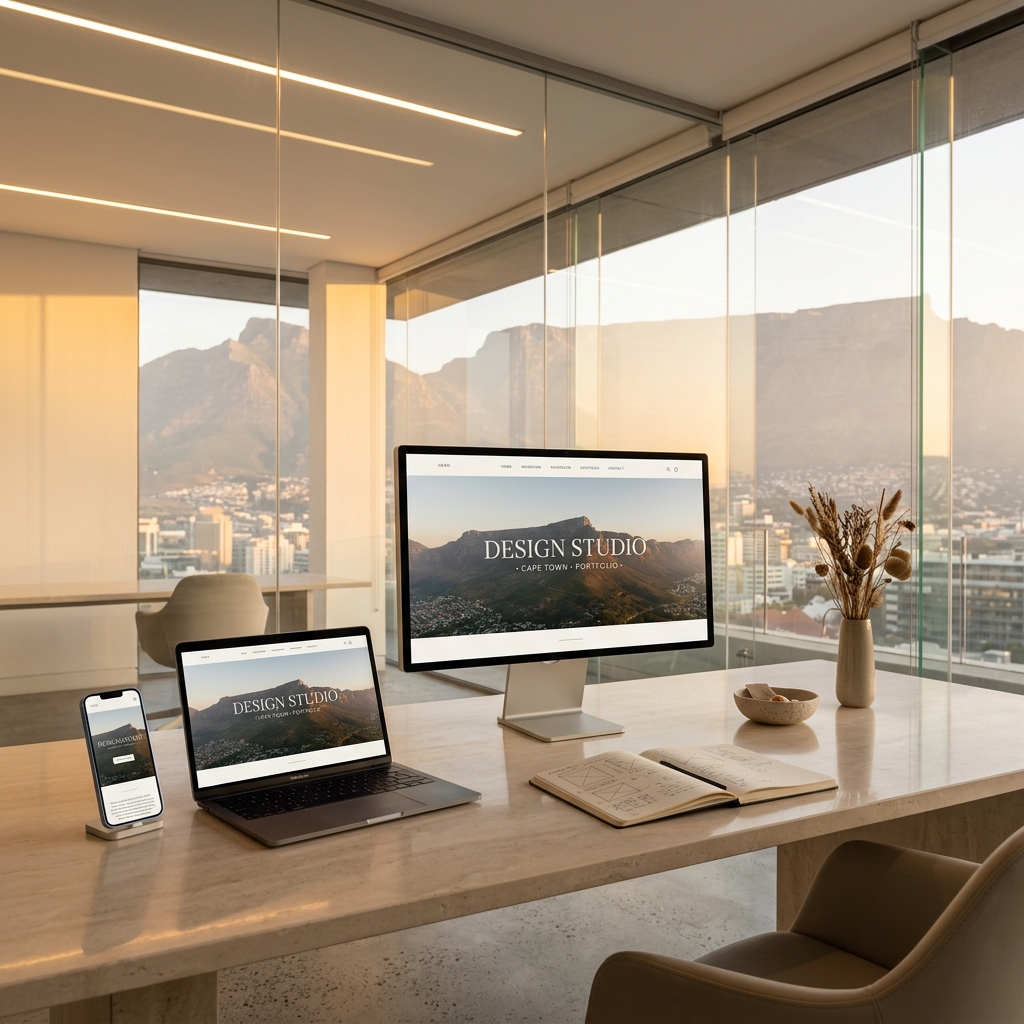
KNOWN is a Cape Town web design and development agency that has designed and built custom, premium websites for businesses in South Africa, the UK and beyond since 2014.
We believe great websites sit at the intersection of creativity, technology and strategy. A premium digital experience should look distinctive, feel intuitive and work hard for the business behind it.
From brand-led website design and UX to custom web development, performance and SEO, every decision contributes to the finished experience. See the results in our work.
Your website shouldn’t simply fill a space on the internet. It should be a digital expression of the quality, ambition and personality of your brand.
Ready for a website designed around your business? Reserve your meeting with KNOWN to talk about your next premium website, or download our free Ultimate Buyers’ Guide to know exactly what’s involved before you commit.